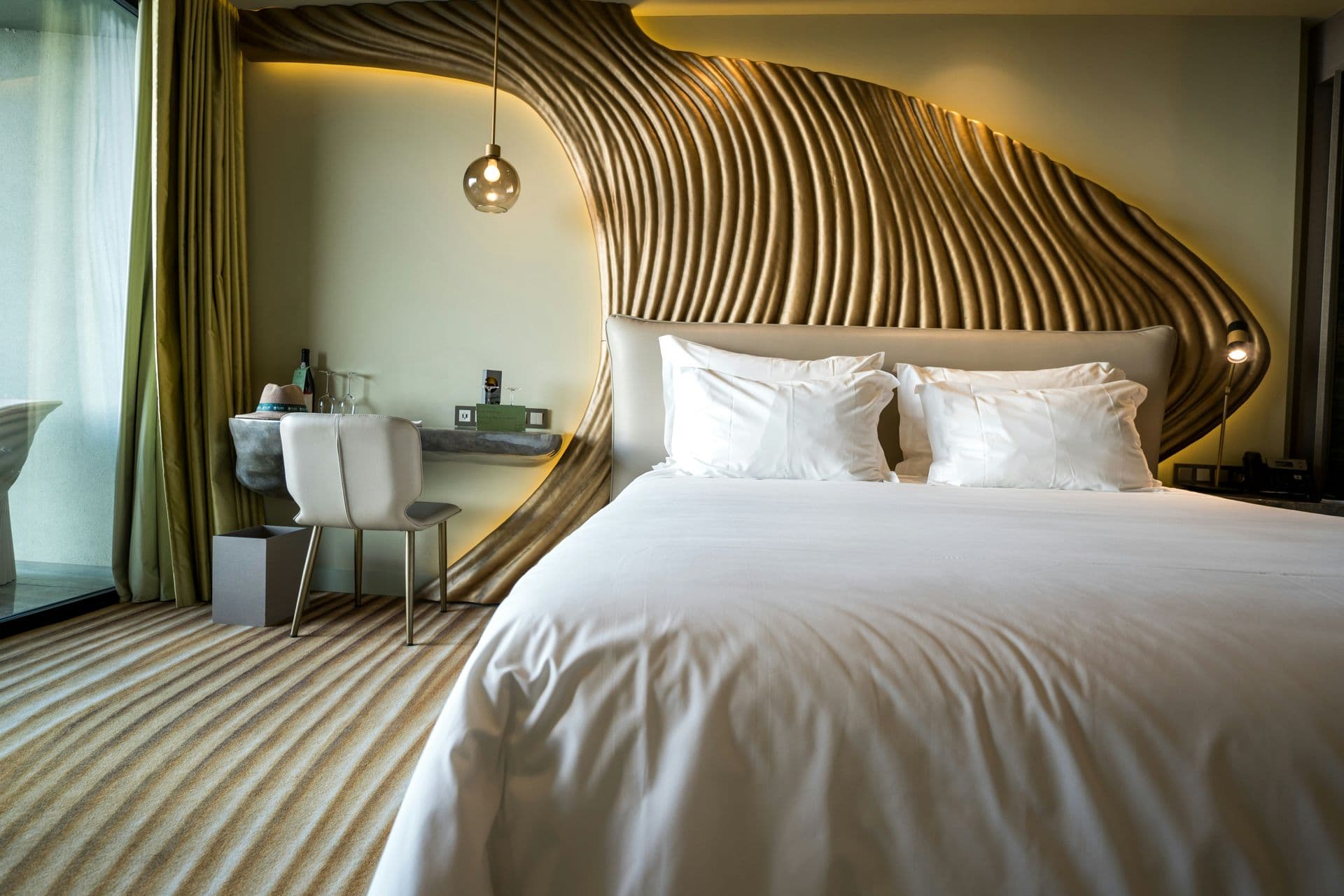
Most hotel commercial directors still think of wellness brand partnerships as a supplier arrangement – a toiletries deal, a branded amenity kit, a co-branded spa menu. That framing captures perhaps fifteen percent of the commercial opportunity. The rest sits in formats that most hotels have not yet explored, generating revenue through channels that RevPAR will never measure.
01The five revenue models available to hotels
Supply contracts are the most familiar format: the hotel buys a wellness brand's products at preferential terms, often with exclusivity in their market. Margin is built into the wholesale price differential. The commercial logic is straightforward, but the revenue ceiling is also relatively low – you are essentially capturing the difference between retail and cost price on product volume.
Revenue share arrangements go further. The brand pays the hotel a percentage of sales generated on-property – through the spa, the minibar, the in-room menu, or a dedicated retail point. This aligns incentives: the brand has skin in the activation, and the hotel benefits from genuine sales performance rather than a flat placement fee. Revenue share deals typically require the hotel to hold stock and provide merchandising support, but the upside scales with guest volume.
Fee-for-placement is common in high-traffic, low-dwell environments – the car park, the spa reception, the luggage hall. The brand pays a fixed fee for prominent visibility at a specific touchpoint, and the hotel treats it as occupancy revenue for that space. No stock required, no sales reporting, predictable income. The trade-off is lower ceiling: the brand is paying for exposure, not sales conversion, so the fee reflects market rate for the audience, not the revenue potential.
Co-creation and exclusive residency formats occupy the top of the value stack. Here the brand and the hotel build something together – a signature treatment developed with a skincare brand, an in-room coffee programme with a speciality roaster, a sleep collection designed with a wellness brand exclusively for that property. These partnerships carry higher setup investment but generate multiple revenue streams simultaneously: product sales, experience revenue, PR value, and a differentiation story that directly supports rate integrity.
The fifth model, which most hotels have not yet activated, is data and audience monetisation. A wellness brand that wants access to the spending behaviour and demographic profile of a luxury hotel's guest base will pay for it – through joint marketing campaigns, email access, or co-branded digital content. The hotel holds the audience; the brand holds the distribution budget. Done properly, this model adds revenue without any operational friction on-property.
02The Quick Journey framework: matching format to touchpoint
Revenue model choice is inseparable from touchpoint context. The same brand can operate through multiple formats across a single property, and the format that makes commercial sense at the spa reception is different from the format that works in the guest room.
High-traffic, low-dwell environments – the car park, the concierge desk, the luggage hall, the massage chair area, the spa entrance – are optimised for fee-for-placement and sampling trigger formats. Guest dwell time here is thirty seconds to three minutes. The commercial opportunity is volume and visibility, not depth of engagement. Brands pay for presence; the revenue is relatively predictable and requires minimal operational support from the hotel.
In-room and deep-engagement environments – the coffee machine, the minibar, the pillow menu, the bath amenity kit, the bedside tablet – are where the higher-value revenue models live. Dwell time is minutes to hours. The guest is stationary, engaged, and commercially receptive. Revenue share, co-creation, and supply contracts with meaningful margin all perform better here because the guest has time to notice, engage with, and purchase the brand experience.
Hotels that map their touchpoints through this lens – what is the dwell time, what is the engagement context, what is the realistic commercial format for each space – tend to generate two to three times the partnership revenue of hotels that treat wellness partnerships as undifferentiated sponsorship deals.
03What TRevPAG reveals that other metrics miss
RevPAR measures room revenue per available room. It tells you nothing about what happens once a guest checks in. TRevPAG – Total Revenue Per Actual Guest – captures the full commercial footprint: rooms, F&B, spa, ancillary sales, and partnership-generated revenue, divided by the number of actual guests rather than available room nights.
Wellness brand partnerships show up directly in TRevPAG. A hotel with a strong in-room wellness programme generating £8 per guest per night in ancillary revenue will have a materially different TRevPAG from a comparable property without one. The benchmark gap between hotels with structured partnership programmes and those without is typically 12–18 percent on TRevPAG, which translates to significant annual revenue at any volume above 20,000 room nights.
The practical implication is that the business case for wellness brand partnerships should be built around TRevPAG improvement, not RevPAR. The former captures the actual revenue contribution; the latter ignores it entirely.
04What drives success versus failure
The most common failure mode is a mismatch between partnership format and guest profile. A premium skincare brand in a hotel whose guests are predominantly short-stay business travellers will underperform – not because the brand is wrong, but because the format requires dwell time that the guest profile does not support. Conversely, a lifestyle supplement brand in a destination wellness resort can generate disproportionate revenue because the guest has specifically chosen an environment of health engagement.
The second failure mode is insufficient activation. Many hotel-brand partnerships exist only at the product level – the brand's name appears on an amenity kit – without any of the storytelling, staff engagement, or guest communication that converts product placement into revenue. A wellness brand that has invested in a supply contract deserves more than shelf space; it needs a reason for the guest to notice, consider, and purchase.
Partnerships that perform consistently share three characteristics: the brand is genuinely relevant to the guest profile, the format is matched to the touchpoint's engagement context, and there is an operational owner at the hotel who understands the revenue model and actively supports it.
How to structure a hotel wellness brand partnership for revenue
A step-by-step process for identifying, structuring, and activating a wellness brand partnership that generates measurable hotel revenue.
- 1
Map your property's partnership touchpoints
Identify every physical space and in-room touchpoint that could carry a brand partnership. Distinguish between high-traffic/light-engagement areas (spa reception, luggage hall, car park) and in-room/deep-engagement areas (coffee machine, bath amenities, pillow menu, bedside tablet). This inventory becomes the foundation of your commercial proposition to brands.
- 2
Define the partnership format for each touchpoint
Match each touchpoint to the appropriate revenue model: fee-for-placement for high-traffic/low-dwell areas; revenue share or supply contract for in-room environments; co-creation or exclusive residency for signature programme opportunities. The format must fit the guest's engagement context at that specific touchpoint.
- 3
Build the commercial case using TRevPAG
Calculate your current TRevPAG and benchmark it against comparable properties in your market. Model the revenue uplift from each proposed partnership format using conservative, moderate, and optimistic assumptions. Produce a one-page financial summary showing the annual revenue opportunity and the breakeven timeline – this is what a GM or CFO needs to approve the programme.
- 4
Identify and evaluate brand partners by touchpoint fit
For each touchpoint opportunity, identify brand categories whose guest profile aligns with your own. A luxury urban hotel needs different wellness brands than a destination spa resort. Evaluate shortlisted brands on guest demographic alignment, brand positioning relative to your property tier, operational simplicity, and the quality of the commercial terms they can offer.
- 5
Negotiate the revenue model and set success metrics
Negotiate with clarity about which format you are proposing and what the revenue expectation is. Agree a clear measurement framework: what revenue metric will be tracked, at what frequency, and what threshold triggers a review. A partnership without agreed success metrics tends to drift toward renewal by inertia rather than performance.
- 6
Activate with staff engagement and guest communication
Product placement without activation generates a fraction of the revenue of a properly supported partnership. Brief front-of-house and spa staff on the brand story and the commercial rationale. Create guest touchpoints that explain the partnership – in-room materials, digital menus, spa consultation scripts. Activation is the difference between a supplier deal and a revenue programme.
Questions hotel commercial directors ask
- What is the most common revenue model for hotel wellness brand partnerships?
- Supply contracts with a preferential wholesale price differential are the most common entry-level format. Revenue share arrangements on in-room or spa product sales are the next most prevalent, particularly for hotels with active spa programmes. Fee-for-placement is common in high-traffic touchpoints. Co-creation and exclusive residency formats are less common but generate the highest revenue per partnership.
- How much revenue can a wellness brand partnership realistically generate?
- Revenue varies significantly by format, hotel tier, and volume. A well-structured in-room wellness programme with revenue share can generate £5–£15 per guest per stay at a luxury property. A fee-for-placement deal in a high-traffic spa environment typically generates £12,000–£40,000 per year depending on footfall. Co-created branded experiences at a destination resort can generate six-figure annual revenue when combined with product sales, PR value, and rate premium. The key metric is TRevPAG improvement – most hotels with structured programmes see 12–18 percent uplift.
- Which hotel touchpoints generate the highest partnership revenue?
- In-room touchpoints consistently generate the highest revenue per partnership because guest dwell time is highest and purchasing intent is most receptive. The in-room coffee programme, bath amenity kit, pillow menu, and minibar curation are the top performers. Spa treatment menu co-creation can generate significant revenue at properties with high spa utilisation. High-traffic touchpoints like the spa reception and luggage hall generate more predictable but lower-ceiling fee-for-placement income.
- Does the hotel or the brand typically initiate these partnerships?
- Historically, brands have initiated most hotel partnership conversations, approaching commercial directors and spa managers with product placement proposals. The dynamic is shifting: hotels with a clear partnership strategy and defined touchpoint inventory are increasingly proactive, approaching brands with a structured commercial proposition rather than waiting to be pitched. This reversal gives the hotel significantly more leverage over format, revenue model, and terms.
- What is TRevPAG and why does it matter for wellness partnerships?
- TRevPAG stands for Total Revenue Per Actual Guest. It measures total on-property revenue – rooms, F&B, spa, and ancillary – divided by the number of actual guests. Unlike RevPAR, which only captures room revenue, TRevPAG reflects the full commercial contribution of every guest. Wellness brand partnerships that generate in-room product sales, spa spend uplift, or ancillary revenue directly improve TRevPAG, making it the most relevant metric for evaluating and building the business case for partnership programmes.